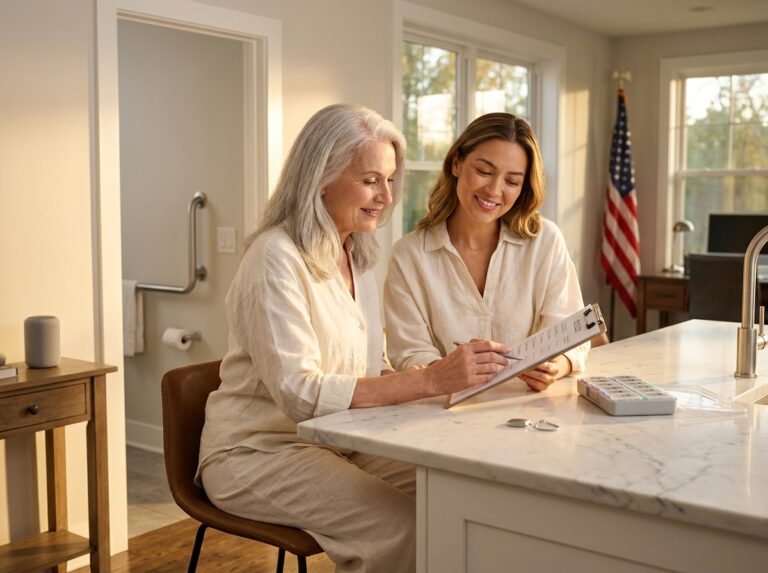
Helping aging parents stay safe and independent at home doesn’t have to break the bank. This guide maps 25 budget-friendly home modifications and the community, government and veteran programs that can help pay for them. You’ll find practical prioritization, cost ranges, DIY tips, and how to combine thoughtful renovations with the right home care and respite services.
Start by Assessing Needs and Setting a Realistic Plan
Before making any changes, the most important step is to understand what’s truly needed. A thoughtful assessment prevents you from spending money on modifications that don’t solve the right problems. This process isn’t about pointing out flaws; it’s a collaborative effort to make your parent’s home safer and more comfortable, empowering them to maintain their independence. The goal is to identify specific challenges and create a practical, prioritized plan that fits your budget.
Start by walking through the home together with your parent, if possible. Their involvement is crucial. They are the expert on their daily routines and frustrations. Ask open-ended questions like, “What’s the hardest part about getting ready in the morning?” or “Do you ever worry about tripping on anything in this hallway?” This approach fosters trust and ensures the changes will actually be used. As you go, document everything. Use your phone to take pictures of potential hazards like a high bathtub wall, a poorly lit staircase, or a rug that always bunches up. These photos will be invaluable when you’re planning and talking to professionals.
Follow a structured audit to make sure you don’t miss anything.
- Entrances and Exits
Check every door they use. Is there a step up or down? Are the thresholds high? Is there adequate lighting outside for nighttime entry? Can they turn the do-oknob and lock easily? - Stairs
Are there sturdy handrails on both sides of the staircase? Is the lighting bright enough to see every step clearly? Are the steps themselves in good repair, without loose carpeting or worn edges? - Bathrooms
This is a high-risk area. How do they get in and out of the tub or shower? Are there secure bars to hold onto? Is the toilet height comfortable, or is it a struggle to stand up? Is the floor slippery when wet? - Kitchen
Can they reach frequently used items in cabinets and the pantry without a step stool? Are the faucet handles easy to turn? Is there good task lighting over the counters and sink? - Lighting and Pathways
Walk through the main pathways, from the bedroom to the bathroom and to the kitchen. Are they clear of clutter, electrical cords, and unnecessary furniture? Are these paths well-lit, especially for nighttime trips?
Alongside the home audit, a simple mobility screening can provide objective insight into fall risk. The Timed Up and Go (TUG) test is a reliable tool used by healthcare professionals that you can do at home. Have your parent sit in a sturdy chair with arms. Time them as they stand up, walk 10 feet (3 meters), turn around, walk back to the chair, and sit down again. A time under 10 seconds is normal. A time between 11 and 20 seconds suggests some mobility limitation, while over 20 seconds indicates a higher fall risk and the need for a professional evaluation.
Once you’ve completed the walk-through and TUG test, organize your findings. Create a simple checklist from your notes and photos. Prioritize each item based on safety impact. A loose rug on the stairs is a high-priority, immediate fix. Hard-to-reach shelves in the kitchen might be a medium priority. This ranking helps you focus your budget where it matters most.
With your prioritized list, it’s time to create a realistic plan. This is best done with a two-tier approach.
- Tier 1: Immediate, Low-Cost Fixes (The Weekend Plan)
These are changes you can make right away for under a few hundred dollars. This tier might include securing all rugs with double-sided tape, installing plug-in motion-sensor night lights in hallways, decluttering pathways, and adding a non-slip mat in the shower. These quick wins build momentum and immediately improve safety. - Tier 2: Longer-Term, Structural Changes (The Phased Plan)
These are bigger projects that require more budget and planning. Examples include converting a bathtub to a walk-in shower, installing a second handrail on the stairs, or widening a doorway. These should be planned over months, allowing time to save money, find funding, and hire qualified contractors.
Finally, know when to call in the experts. If the TUG test result is high, if your parent has had a recent fall, or if you’re unsure how to address a complex issue like bathroom modifications, it’s time for a professional assessment. An Occupational Therapist (OT) can perform a comprehensive home safety evaluation and recommend specific modifications and adaptive equipment tailored to your parent’s functional abilities. A Physical Therapist (PT) can help address underlying strength and balance issues. Your local Area Agency on Aging (AAA) is an essential, often free, resource. They can connect you with OTs, reputable contractors, and potential funding programs in your community. A professional evaluation provides a clear roadmap and can be a requirement for accessing grants or other financial assistance. For those in rental housing, remember that under the Fair Housing Act, landlords must allow tenants to make reasonable, necessary modifications at the tenant’s expense. You must get written permission first and may be required to restore the unit to its original condition upon moving out. Focus on reversible solutions like tension-mounted safety poles, bath transfer benches, and freestanding toilet safety frames whenever possible.
25 Essential Budget-Friendly Modifications with Cost Guidance
After your home assessment, you likely have a list of potential changes. This itemized guide breaks down 25 essential modifications, from simple fixes to more involved projects, to help you prioritize. Many families find their homes need adjustments to be truly safe for aging in place. In fact, AARP data shows that 43% of adults age 50 and older believe their homes would need changes to remain safe and accessible. Here are practical options organized by room, complete with cost estimates, safety notes, and budget-friendly tips.
When deciding between a do-it-yourself approach and hiring a professional, use safety as your guide. DIY is perfect for simple tasks that don’t affect the home’s structure, plumbing, or electrical systems. You can safely assemble a shower chair, change lightbulbs, apply non-slip tape, and remove clutter. Hire a licensed and insured professional for any job that requires specialized skills. This includes installing grab bars, widening doorways, building a ramp, or doing any electrical or plumbing work. If a mistake could lead to a fall, a fire, or a flood, it is always worth the investment to hire a pro.
Bathroom Safety
-
1. Grab Bars by Toilet and Tub/Shower
These provide critical support for transfers, reducing fall risk in wet areas. Cost: DIY kits $20–$60; Pro install $100–$300 per bar. Safety: Must be anchored directly into wall studs or solid wood blocking by a qualified installer to support hundreds of pounds of force. An improperly installed bar is more dangerous than no bar at all. Never rely on suction-cup bars for weight support; they are for balance aid only. Durability: 10+ years. Permits: No. Tip: Position one vertically at the tub entrance and horizontally along the back wall. -
2. Raised or Comfort-Height Toilet
A toilet seat 17–19 inches high makes sitting and standing much easier. Cost: Add-on seat $30–$200; Pro install of a new toilet $300–$800. Safety: Ensure any add-on seat is securely fastened. Durability: Seats 2–5 years; new toilet 10+ years. Permits: No. Tip: An add-on seat is a low-cost, effective alternative to a full replacement. -
3. Walk-in Shower or Transfer Bench
Eliminates the need to step over a high tub wall, a major fall hazard. Cost: Transfer bench $30–$250; Pro shower conversion $3,000–$10,000. Safety: A bench must be stable and rated for the user’s weight. Durability: Bench 5+ years; conversion 15+ years. Permits: Yes for conversions. Tip: A transfer bench is an excellent, immediate solution on a tight budget. -
4. Non-Slip Flooring and Secured Rugs
Improves traction on slick surfaces. Cost: DIY anti-slip coating $30–$150; double-sided rug tape $10. Safety: Remove throw rugs entirely or secure all edges firmly. Durability: Coatings last 1–3 years. Permits: No. Tip: Look for bath mats with strong, non-slip rubber backing. -
5. Shower Seat or Fold-Down Bench
Allows for seated bathing to conserve energy and prevent falls from dizziness or fatigue. Cost: Freestanding seat $40–$100; Pro install of wall-mounted bench $200–$550. Safety: Wall-mounted units require secure anchoring into wall blocking. Durability: 5–10 years. Permits: No. Tip: Fold-down models are ideal for small, shared bathrooms. -
6. Handheld Shower Head
Makes seated bathing and caregiver assistance easier. Cost: DIY kit $15–$150. Safety: Ensure the hose is long enough for reach but not so long it becomes a trip hazard. Durability: 5–10 years. Permits: No. Tip: Choose a model with an easy-to-use on/off switch on the handle. -
7. Anti-Scald Valve
Prevents burns by maintaining a safe, consistent water temperature. Cost: Pro install $250–$600. Safety: The U.S. CPSC recommends setting the maximum water heater temperature to 120°F. Durability: 10+ years. Permits: Often required. Tip: This is a critical safety feature for anyone with delayed reaction times or sensory loss.
Bedroom and Living Area Comfort
-
8. Lever-Style Door and Faucet Handles
Easy to operate with a closed fist or elbow, ideal for those with arthritis or limited grip strength. Cost: DIY kits $15–$60 per handle. Durability: 10+ years. Permits: No. Tip: Start with the most frequently used doors, like the bathroom and bedroom. -
9. Bed-Height Adjustments and Transfer Aids
Ensures a safe transition into and out of bed. Cost: Bed risers $10–$60; Bed rails $50–$300. Safety: Bed rails can pose an entrapment risk and must be installed and used carefully. Durability: 5–10 years. Permits: No. Tip: The ideal bed height allows your parent to sit on the edge with their feet flat on the floor. -
10. Chair Risers and Lift Chairs
Reduces the strain of standing up from a seated position. Cost: Furniture risers $10–$40; Power lift recliner $600–$4,000+. Safety: Ensure risers are sturdy and fit the chair legs properly. Durability: Risers 5+ years; chair 5–10 years. Permits: No. Tip: Medicare Part B may help cover the cost of the lifting mechanism in a lift chair if prescribed by a doctor. -
11. Decluttering and Furniture Rearrangement
Creates wide, clear pathways to prevent trips and falls. Cost: $0. Safety: Aim for pathways at least 36 inches wide, especially if a walker or wheelchair is used. Remove loose electrical cords and unnecessary furniture. Durability: An ongoing process. Permits: No. Tip: This is the most cost-effective safety modification you can make.
Circulation, Entrances, and Kitchen
-
12. Sturdy Stair Railings and Second Handrail
Provides crucial support on both sides of a staircase for ascent and descent. Cost: Pro install of a second handrail $350–$1,400. Safety: Railings must be securely anchored to support full body weight. Durability: 20+ years. Permits: Sometimes required. Tip: Ensure the railing is continuous and easy to grip. -
13. Stairlift Options
A mechanical chair that moves along a rail on the stairs, eliminating the biggest barrier in a multi-story home. Cost: New straight models $3,000–$6,000; curved models start at $8,000. Safety: Professional installation is mandatory. Durability: 10+ years with regular maintenance. Permits: Sometimes. Tip: Renting a stairlift can be a cost-effective option for short-term needs. -
14. Threshold Ramps
Creates a smooth surface over raised doorways or small steps. Cost: Portable rubber or aluminum ramps $50–$600. Safety: Choose a ramp with a non-slip surface and a gradual slope. Durability: 5–15 years. Permits: No for portable ramps. Tip: Portable ramps are great for renters as they don’t require permanent installation. -
15. Doorway Widening
Necessary for wheelchair and some walker access, typically requiring a 32 to 36-inch opening. Cost: Pro install $800–$3,500 per door. Safety: A contractor must determine if a wall is load-bearing before work begins. Durability: Permanent. Permits: Yes, for structural changes. Tip: Offset hinges can add about 2 inches of clearance for under $50, a great first step. -
16. Removal of Interior Thresholds
Eliminates a common trip hazard between rooms. Cost: Pro removal and flooring transition $120–$500 per doorway. Safety: Ensure the transition between different flooring types is smooth and level. Durability: Permanent. Permits: No. Tip: Use a low-profile transition strip to bridge gaps. -
17. Pull-Out Shelves in Kitchen
Brings cabinet contents out, reducing the need for deep bending or reaching. Cost: DIY kits $30–$200 per shelf. Durability: 10+ years. Permits: No. Tip: Start by retrofitting the cabinets used most often, like those for pots and pans. -
18. Single-Lever Faucets in Kitchen
Allows for easy control of water flow and temperature with one hand. Cost: DIY faucet replacement $40–$300. Durability: 10+ years. Permits: Maybe. Tip: A high-arc, pull-down model makes it easier to fill large pots and clean the sink.
Lighting, Communication, and Emergency Systems
-
19. Improved LED Lighting
Bright, even lighting reduces shadows and helps prevent falls. Cost: Bulbs $3–$15 each. Safety: Use bulbs that minimize glare. Durability: LEDs can last over 15,000 hours. Permits: Yes, if new wiring is needed. Tip: Layer lighting with ambient overhead fixtures and focused task lights over sinks and counters. -
20. Motion-Activated Night Lights
Provides automatic, low-level light for safe nighttime navigation. Cost: Plug-in or battery-powered units $5–$30 each. Durability: 1–5 years. Permits: No. Tip: Place them along the path from the bedroom to the bathroom. -
21. Smart Pill Dispensers
Helps manage complex medication schedules with alerts and timed dispensing. Cost: Devices $80–$400, some with monthly service fees. Durability: 3–5 years. Permits: No. Tip: As a low-tech alternative, ask the pharmacy about providing medications in pre-sorted blister packs. -
22. Personal Emergency Response Systems (PERS)
A wearable pendant or watch that provides a direct line to emergency services. Cost: $20–$60 per month, plus potential equipment fees. Safety: Look for systems with automatic fall detection for added protection. Durability: Service-based. Permits: No. Tip: Test the system monthly to ensure it’s working correctly. -
23. Enhanced Smoke and CO Detectors
Crucial for early warning, especially for those with hearing or mobility impairments. Cost: Units with strobe lights or louder alarms $30–$150 each. Safety: Replace all detectors every 10 years. Durability: 10 years. Permits: No for battery units. Tip: Interconnected alarms that sound throughout the house offer the best protection. -
24. Simple Home Monitoring Cameras
Video doorbells or simple interior cameras can provide peace of mind for family caregivers. Cost: $80–$300, plus optional cloud storage fees. Safety: Always discuss monitoring with your parent to respect their dignity and privacy. Never place cameras in private spaces like bedrooms or bathrooms. Durability: 5–10 years. Permits: No. -
25. Remote-Controlled Devices
Smart thermostats and remote-controlled window coverings reduce the need to get up to make adjustments. Cost: Smart thermostat $100–$300. Durability: 5–10 years. Permits: Maybe for thermostat wiring. Tip: Smart plugs ($10–$25 each) can turn any lamp into a voice or app-controlled light.
Sample Budgets for Prioritization
Making changes can feel overwhelming, but even a small budget can have a huge impact on safety. Here’s how you might allocate funds.
- $500 Budget (Immediate Safety Focus)
This budget tackles the most common fall risks. Allocate funds for DIY grab bars ($100), a handheld shower head ($40), a raised toilet seat ($50), motion-activated night lights ($30), and rug tape ($10). Keep a small amount for other minor fixes. - $2,500 Budget (Targeted Professional Upgrades)
With a larger budget, you can hire professionals for key installations. This could cover professional installation of grab bars ($500), a new comfort-height toilet ($700), a wall-mounted shower seat ($300), and adding a second handrail to a staircase ($500). - $10,000 Budget (Major Accessibility Projects)
This allows for a significant structural change. The priority would be a low-threshold or walk-in shower conversion ($6,000–$8,000). Remaining funds could go toward installing permanent threshold ramps ($1,000) or widening a critical doorway ($1,000).
Funding Options and Programs to Stretch Every Dollar
After identifying the necessary modifications, the next question is always, “How do we pay for this?” The costs can feel daunting, but a surprising number of resources exist if you know where to look. Navigating these programs takes patience, but the savings can make essential safety upgrades possible.
First, it’s important to understand the roles of major federal health programs. Medicare, for instance, generally does not pay for home modifications like walk-in showers, ramps, or widened doorways. Its focus is on medical care. However, Medicare Part B may cover some “durable medical equipment” (DME) when prescribed by a doctor as medically necessary. This includes items like walkers, hospital beds, and patient lifts. It can also cover skilled home health services, such as visits from a nurse or physical therapist, but not long-term personal care or structural changes to the home.
Medicaid, on the other hand, can be a significant source of funding through state-specific Home and Community-Based Services (HCBS) waivers. These programs are designed to help eligible individuals receive care in their own homes rather than in institutions. Many HCBS waivers cover environmental accessibility adaptations. Because each state runs its own program, eligibility rules and covered modifications vary widely. To find your state’s programs, search online for “[Your State] Medicaid HCBS waiver” or contact your state’s Medicaid agency. Be prepared for potential waiting lists, which can last months or even years in some states.
For veterans, the Department of Veterans Affairs (VA) offers several valuable benefits. Aid and Attendance is a monthly pension supplement for qualifying veterans and surviving spouses who need help with daily activities. While not designated for modifications, this tax-free benefit can free up personal funds for home projects. The VA also offers direct grants for home adaptations for veterans with certain service-connected disabilities, such as the Specially Adapted Housing (SAH) and Home Improvements and Structural Alterations (HISA) grants. The best starting point is to contact your nearest VA regional benefits office.
Beyond federal programs, look to state and local resources.
- Area Agencies on Aging (AAAs) are your local command center for senior services. They can provide information, conduct in-home assessments, and refer you to local grant and volunteer programs. You can find your local AAA through the national Eldercare Locator service or by calling 2-1-1.
- State and Local Housing Programs often offer low-interest loans or grants for home repairs and accessibility modifications, especially for low-to-moderate-income homeowners. These are sometimes called housing rehabilitation programs and may be funded by federal sources like the Community Development Block Grant (CDBG).
- USDA Section 504 Home Repair Program provides loans and grants to very low-income homeowners in eligible rural areas to remove health and safety hazards.
- The Weatherization Assistance Program (WAP), while focused on energy efficiency, can sometimes include minor health and safety repairs as part of its work.
National nonprofits with local chapters are another excellent avenue. Organizations like Rebuilding Together and Habitat for Humanity have repair programs that provide free or low-cost home modifications and repairs for eligible homeowners, often relying on volunteer labor. Easterseals also offers home modification services and funding assistance in some areas.
If grants and free services aren’t available, consider financial tools. A home equity loan or line of credit (HELOC) can provide the necessary funds, but you’ll be taking on debt. A Home Equity Conversion Mortgage (HECM), or reverse mortgage, allows homeowners 62 and older to convert home equity into cash without monthly mortgage payments. However, this is a complex financial product with significant risks, including high closing costs and reducing the equity left to heirs. It is mandatory to consult a HUD-approved HECM counselor before proceeding. Finally, don’t overlook smaller charitable grants from local community foundations or crowdfunding on sites like GoFundMe for specific, urgent needs.
To apply for most of these programs, you’ll need to be organized. Start by gathering a folder with the following documents:
- Proof of income (recent tax returns, Social Security statements)
- Proof of homeownership (deed or property tax bill) or a rental agreement with written landlord permission for modifications
- A statement from a physician or occupational therapist detailing the medical necessity of the requested modifications
- Photos of the areas in the home that need modification
- Written estimates from at least two or three licensed contractors for the proposed work
Processing times vary from a few weeks to many months. When working with a caseworker, be polite, persistent, and keep copies of everything you submit. For complex situations, like navigating Medicaid appeals or integrating modifications into estate planning, consider hiring a benefits navigator or an elder law attorney.
Finally, always confirm program details with your local agency, as rules and funding levels change. Before making any major financial decisions, consult with a trusted financial advisor and a tax professional, as some medically necessary modifications may be tax-deductible.
Choosing Home and Residential Care Services and Balancing Modifications with Support
Even the most thoughtfully modified home can’t eliminate the need for human support. Physical changes like grab bars and ramps are crucial, but they work best as part of a larger care ecosystem that includes professional services. This combination of environmental safety and personal assistance is often the key to sustainable, long-term independence. Understanding the types of available care, how to vet providers, and when to use them is just as important as installing the right hardware.
Types of Care Services and Their Costs
Navigating the world of senior care can feel overwhelming. Services are designed to meet different needs, and their payment models vary significantly. Here’s a breakdown of the most common options.
- Private-Pay Home Care
This involves hiring an aide for non-medical help with Activities of Daily Living (ADLs) like bathing, dressing, and meal preparation. You can hire through an agency or find an independent caregiver. Agencies handle vetting, payroll, and backup care, but cost more, typically $25 to $35 per hour. Independent caregivers are less expensive but require you to manage taxes, insurance, and scheduling. Live-in care is another model, often involving a flat daily or weekly rate, but rules on overtime and sleep breaks vary by state. - Medicaid-Funded Personal Care
For those who qualify financially, state Medicaid Home and Community-Based Services (HCBS) waivers can fund personal care. These programs pay an agency or, in some states, allow you to hire a relative or friend through a consumer-directed program. The services are similar to private-pay care but are governed by a state-approved care plan. - Short-Term Skilled Home Health
This is medical care prescribed by a doctor, often after a hospitalization. It is typically covered by Medicare for a limited time. Services include nursing care, physical therapy, or occupational therapy. This is not for long-term daily help; it’s for recovery and rehabilitation. - Adult Day Services
These centers provide a safe, social environment for seniors during the day, offering meals, activities, and some health monitoring. It’s an excellent source of respite for family caregivers and costs are usually a flat daily rate, often more affordable than several hours of in-home care. - Respite Care
Designed to give family caregivers a break, respite can be a few hours of in-home help, a weekend stay at an adult day center, or a short-term stay in an assisted living facility. Costs vary based on the setting and duration. - Assisted Living and Nursing Facilities
When home care is no longer safe or sufficient, residential care is the next step. Assisted living facilities offer apartment-style living with support for meals, medication, and personal care, paid via a monthly room-and-board fee. Nursing facilities provide 24/7 skilled nursing care for those with complex medical needs and are the most intensive, expensive option.
A Step-by-Step Process for Selecting a Care Provider
Choosing the right person or agency to care for your parent is a critical decision. A methodical approach ensures safety and quality.
- Check Licensing and Credentials
Home care agencies should be licensed by the state (if required) and bonded and insured. Ask for proof. For independent caregivers, verify any certifications they claim, such as Certified Nursing Assistant (CNA) or Home Health Aide (HHA). - Conduct Thorough Background and Reference Checks
Always run a national criminal background check on an independent caregiver. For agencies, ask what their screening process includes. Call at least two professional references and ask specific questions like, “How did the caregiver handle a difficult situation?” or “Were they consistently punctual and reliable?” - Interview Smart
During the interview, go beyond basic qualifications. Ask situational questions.- For Agencies: “What is your process for creating a care plan?” “How do you handle client complaints?” “What happens if our regular aide is sick?”
- For Individuals: “Describe a time you had to manage a medical emergency.” “How do you approach communicating with the family?” “What are your boundaries regarding personal errands or housekeeping?”
- Review the Contract and Scope of Work
A professional agreement should clearly outline duties, hours, pay rate, and procedures for termination. Vague contracts are a red flag. The scope of work should detail every task, from medication reminders to laundry, to avoid misunderstandings.
Watch for red flags like providers who are hesitant to provide references, ask for large upfront payments, or lack a professional communication style. Trust your instincts; if something feels off, it probably is.
Creating a Coordinated and Monitored Care Plan
The goal is to pair modifications with services strategically. For example, a stairlift solves the problem of getting upstairs, but an aide ensures your parent uses it safely and assists with bathing and dressing once they are up there. A coordinated plan might specify that an aide visits three mornings a week to help with bathing (using the new walk-in shower) and meal prep for the day. For medication, a smart pill dispenser provides reminders, while the aide checks that pills were taken correctly.
To ensure quality, establish clear communication channels. A shared care log (a simple notebook or a digital app) where family and caregivers can note changes in health, mood, or appetite is invaluable. Schedule periodic reassessments every few months to review the care plan and adjust it as your parent’s needs change. Finally, remember that even with the best modifications and in-home support, there may come a time when a parent’s cognitive decline or medical needs make residential care the safest option. Constant wandering, unmanageable incontinence, or the need for 24/7 medical supervision are signs that it may be time to transition to a facility. The number of Americans providing care for loved ones has surged, as noted in a 2020 AARP report, highlighting the growing need for these support systems. You can read more in the AARP’s Caregiving in the U.S. survey.
Closing Summary and Practical Next Steps
Putting these ideas into practice is the most critical step in creating a safer home for your parents. The goal isn’t to transform their house overnight but to make strategic, incremental changes that significantly reduce risk while respecting their comfort and autonomy. This journey is a marathon, not a sprint. It begins with a clear-eyed assessment of your parent’s specific needs, followed by a thoughtful mix of low-cost, do-it-yourself modifications and targeted professional help for more complex tasks. Remember, you don’t have to fund this all on your own. A wealth of resources, from Medicaid Home and Community-Based Services (HCBS) waivers to veterans’ grants and local nonprofit programs, exists to help offset the costs of necessary adaptations. The key is to know where to look and how to prepare. By prioritizing changes based on the highest safety risks and systematically exploring funding options, you can make a profound difference without breaking the bank.
The path forward can feel overwhelming, but breaking it down into manageable steps makes it achievable. Here is a practical action plan your family can start this week to build momentum and turn intention into reality.
-
Conduct a Family Walk-Through Audit.
Set aside an hour this week to walk through your parent’s home with them, if possible. Look at the space through the lens of safety and accessibility. Start at the main entrance and move through each room, paying close attention to high-risk areas like bathrooms, stairs, and the kitchen. Use your phone to take pictures of potential hazards such as poor lighting, loose rugs, high thresholds, and tubs that are difficult to step into. Make a simple, prioritized list of what you find. This visual record is not just for your planning; it will be invaluable if you apply for grants or assistance programs. -
Install Two Immediate, Low-Cost Fixes.
Action builds confidence. Based on your audit, choose two simple, high-impact modifications you can complete this weekend for under $100. This could be as straightforward as removing all throw rugs, installing plug-in motion-sensor nightlights in the hallway and bathroom, or replacing standard doorknobs with easier-to-use lever handles. Another great option is installing a quality, properly anchored grab bar next to the toilet. These small wins provide an immediate safety boost and demonstrate that progress is possible without a major renovation. -
Contact Your Local Area Agency on Aging (AAA).
Make one phone call. Your local AAA is the single most important resource for navigating senior services. They are the gateway to information on everything from in-home safety assessments and local handyman programs to meal delivery services and respite care. Ask them about eligibility for state-funded programs, including Medicaid waivers that may cover home modifications. They can provide unbiased advice and connect you with trusted, vetted local providers and nonprofits you might not find otherwise. Use the national Eldercare Locator or call 2-1-1 to find the office serving your parent’s community. -
Get One Professional Estimate for a Larger Project.
Even if you aren’t ready to commit, knowledge is power. Identify one larger-scale modification from your audit that would make a significant difference, like converting a tub to a walk-in shower or building a ramp. Contact a reputable, licensed contractor who specializes in aging-in-place modifications and request a detailed written estimate. This step accomplishes two things: it gives you a realistic budget for future planning and provides the required documentation for many grant and loan applications, which often require at least one, if not three, professional bids. -
Compile a “Benefits-Ready” Documentation Folder.
Many assistance programs require the same core documents. Getting them organized now will save you immense time and stress later. Create a physical or digital folder and gather essential paperwork: proof of homeownership, recent income verification (like a tax return or Social Security statement), a copy of their ID, and if applicable, military discharge papers (DD 214). If you can, ask their primary care physician for a brief letter outlining their medical conditions and stating that specific home modifications are medically necessary for their safety. This documentation is the foundation for nearly every application you will submit.
Ultimately, this process is about finding a sustainable balance between safety, independence, and dignity. It involves open conversations and collaborative decisions. While many changes are simple, don’t hesitate to seek a professional assessment from an Occupational Therapist (OT) if you’re unsure where to start. Their expertise in matching a person’s abilities to their environment is invaluable. You are not alone in this; research shows that a significant number of adults recognize the need for these changes to age safely at home. By taking these first practical steps, you are building a foundation of support that honors your parents’ desire to remain in the home they love for as long as possible.
References
- Caregiving in the U.S. 2020 – AARP — This joint report from the National Alliance for Caregiving (NAC) and AARP provides a comprehensive profile of family caregivers in the United States.
- Home sweet home: A majority of Americans want to age in place – Empower — Cites AARP data showing that 43% of adults age 50 and older believe their current homes would need modifications to make them safe and accessible.
- Eldercare Locator – Administration for Community Living — A public service connecting you to services for older adults and their families.
Legal Disclaimers & Brand Notices
Informational Content Only: The content provided in this article, including discussions of home safety audits, mobility screenings (such as the Timed Up and Go test), fall risk assessments, and recommendations for home modifications, is for informational and educational purposes only. It is not intended to be a substitute for professional medical advice, diagnosis, or treatment from a qualified healthcare provider, such as a physician, physical therapist, or occupational therapist. Always seek the advice of your doctor or other qualified health professional with any questions you may have regarding a medical condition, mobility issues, or before undertaking any physical changes to a home based on health needs.
Professional Consultation: Specific recommendations regarding medical necessity, such as those related to Durable Medical Equipment (DME) or structural changes, must be confirmed by a licensed healthcare professional (e.g., Occupational Therapist or Physician) and a licensed, insured contractor. Reliance on any information provided in this article is solely at your own risk.
Trademark Acknowledgement: All product names, logos, and brands mentioned (including, but not limited to, Medicare, Medicaid, VA, AARP, and specific government programs) are the property of their respective owners. The use of these names, trademarks, and brands does not imply endorsement or affiliation.